Webb Systems Essay
Steam Is Not a Store
The ecosystem beyond the storefront.
Steam is usually described as a digital storefront.
That description is accurate in the same way that describing a city as a collection of buildings is accurate. It identifies something visible while missing the system that makes it consequential.
Valve sells games. It maintains libraries, processes payments, distributes updates, and gives developers access to a massive PC audience. But none of those functions fully explain Steam’s position in games.
Competitors have reproduced many of them.
Stores can be built. Libraries can be built. Achievements, reviews, wishlists, forums, cloud saves, social features, recommendations, and subscriptions can all be built.
Yet reproducing Steam has proven considerably more difficult.
The reason may be that Steam’s real advantage does not end at the boundary of Steam.
It extends into Discord servers Valve does not operate. Twitch streams Valve does not commission. YouTube channels Valve does not own. Wikis Valve does not host. Modding communities Valve does not manage. Reddit threads, guides, clips, tournaments, tools, creators, and communities can all increase the value of games sold through Steam without becoming Steam products.
Steam is surrounded by infrastructure built by other people.
And because Steam sits on the PC, much of that infrastructure can simply attach.
I.
The Platform Around the Platform
Steam itself already contains substantial cultural infrastructure.
Every Steam product can have its own Community Hub. Players can create discussions, upload content, publish guides, write reviews, share screenshots, and participate in Workshop ecosystems where supported. Steam records playtime, maintains libraries, connects friends, surfaces activity, tracks achievements, and allows developers to communicate with players.
Researchers have noticed this expansion.
Stefan Werning’s analysis of Steam’s development between 2007 and 2018 describes a platform that evolved beyond digital distribution toward something resembling a social network, combining commerce with public activity around the games it distributes. Anne Mette Thorhauge goes further, describing Steam as a collection of interconnected and mutually dependent markets rather than a singular retail environment.
The storefront is therefore only one layer.
But even this expanded definition remains incomplete.
Because some of the most important places where Steam games exist are not on Steam at all.
A player discovers a game watching Twitch.
They send a clip through Discord.
Someone watches a YouTube video about it.
Another player adds the game to a Steam wishlist.
A Discord server organizes a group.
They purchase the game.
Someone creates a mod.
Someone else publishes a guide.
A creator produces another video six months later.
The game returns to circulation.
What appears from the perspective of an individual company to be a collection of unrelated services begins to look, from the perspective of the player, like one cultural system.
Steam is near its center.
But Valve does not control the whole thing.
That may be precisely why it works.
II.
Attention Happens Somewhere Else
The modern game industry produces extraordinary amounts of attention outside the platforms where games are purchased.
Twitch provides one of the clearest examples.
In a 2025 Marketing Science study, Yufeng Huang and Ilya Morozov tracked 60,000 popular Twitch streamers at ten-minute intervals over eight months. They found that increases in viewership increased concurrent play. The estimated elasticity was 0.027. Sponsored streams could also provoke additional organic broadcasts from other creators.
But the effect had another characteristic.
It disappeared quickly.
The researchers found that the increase in play associated with streaming dissipated within a few hours.
This is important beyond influencer marketing.
It describes something fundamental about cultural attention.
Attention moves.
A streamer plays a game today. A clip circulates tonight. A meme explodes tomorrow. A tournament happens this weekend. A creator discovers a forgotten game three years after release.
Then the Internet moves somewhere else.
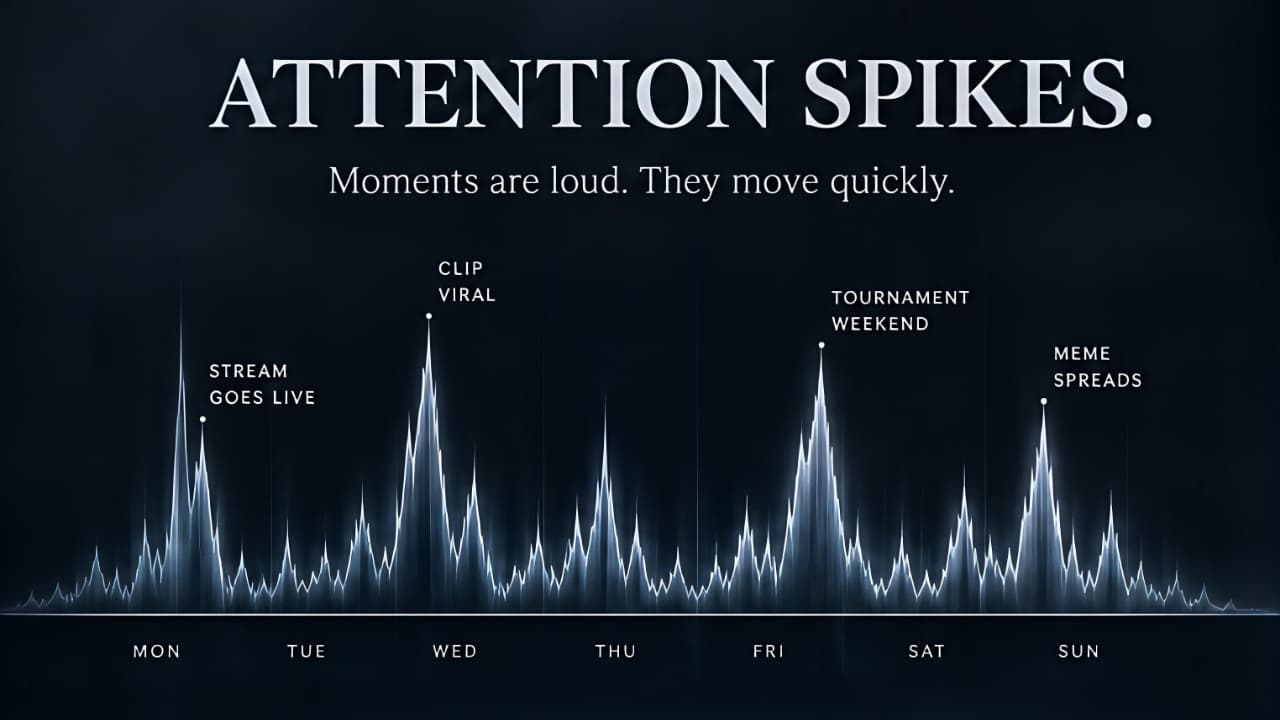
Platforms built primarily around feeds are extremely good at generating these moments. They are much worse at preserving the relationships those moments create.
Steam can preserve some of them.
A player sees a game and wishlists it.
The stream ends.
The wishlist remains.
A player purchases a game.
The cultural moment passes.
The game remains in the library.
A player writes a review.
The conversation moves on.
The review becomes part of the game’s accumulated public history.
Steam’s own wishlist reporting tracks additions, purchases, and deletions over time. Its review system ties public recommendations to recorded playtime and maintains both recent and lifetime reception. Community Hubs collect discussions and player-created material around individual products.
Temporary activity can become persistent state.
This suggests a useful distinction.
Attention spikes. Infrastructure accumulates.
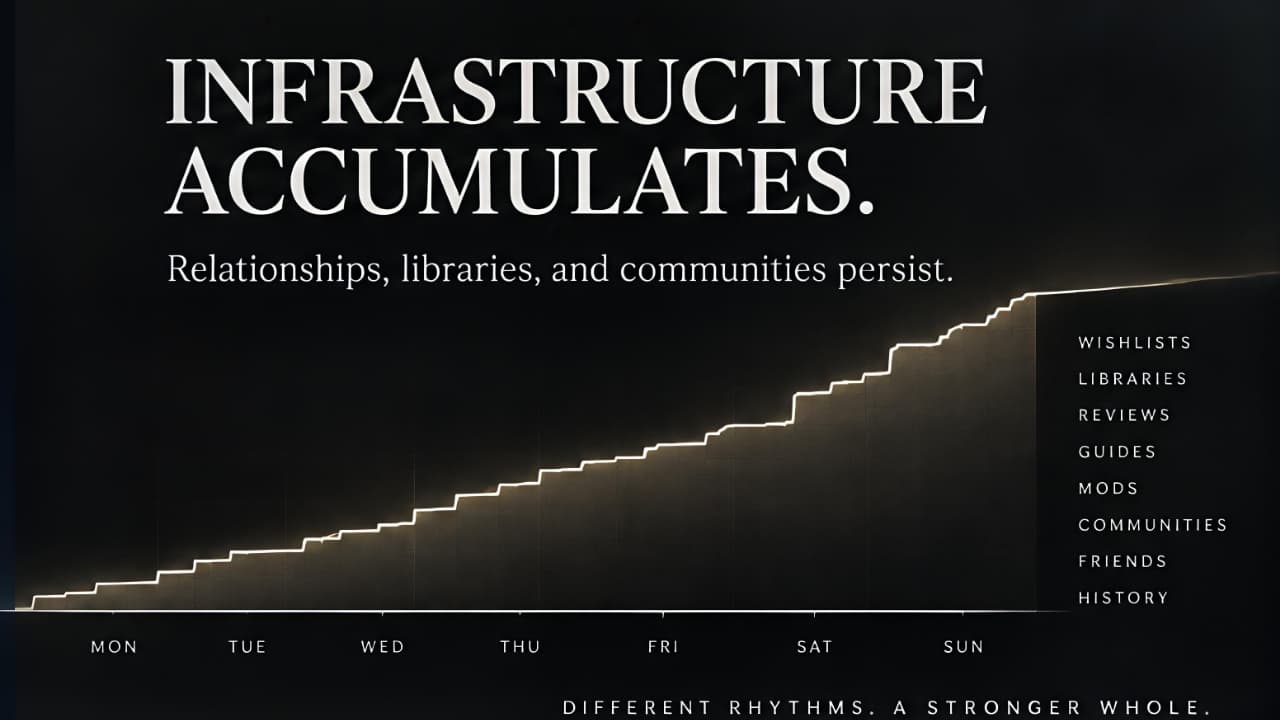
Steam benefits from both.
But it does not have to produce all of the attention itself.
III.
Discord Is Part of the Game
Discord makes the boundary even harder to define.
Discord now describes itself explicitly as a social layer for games. Its developer documentation argues that game communities persist there even when their members are not actively playing. Players coordinate sessions, share discoveries, talk to developers, organize events, exchange memes, troubleshoot problems, and maintain relationships with one another between sessions.
This activity is technically external to Steam.
Culturally, that distinction becomes much less meaningful.
If a Discord server keeps a community interested in a game for two years, that server has extended the cultural life of the game.
If someone sees a friend playing through Rich Presence and joins them, Discord has participated in discovery.
If a community organizes an event that causes hundreds of former players to reinstall a game from their Steam libraries, an external social platform has created internal activity.
Discord reports that roughly 40 percent of PC players in its 2025 internal data started a game within an hour of watching someone stream that game on Discord. The number should be treated as company-reported rather than independent research, but the behavior it describes is revealing.
The boundary between talking about a game and playing a game has become porous.
So has the boundary between platforms.
Discord does not need to become Steam to make Steam more valuable.
Steam does not need to become Discord to benefit from Discord.
The systems can remain independent and still reinforce one another.
IV.
Incompleteness Can Be an Advantage
Technology companies are often tempted by vertical integration.
If users communicate somewhere else, build communication.
If creators publish somewhere else, build creator tools.
If people watch video somewhere else, build video.
If communities organize somewhere else, build communities.
Eventually the platform attempts to contain the entire experience.
Steam has attempted many of these functions itself. It has chat, broadcasting, discussions, groups, guides, reviews, Workshop, and Community Hubs.
But Steam did not need its version of every function to maintain its position.
Steam Chat did not have to prevent Discord from becoming important.
Steam Broadcasting did not have to defeat Twitch.
Steam Community did not have to replace Reddit.
Steam guides did not have to eliminate YouTube tutorials.
The continued existence of those external systems did not necessarily weaken Steam.
They could make the games on Steam more valuable.
That produces an unusual architectural condition:
Steam can benefit from products that outperform parts of Steam.
If players prefer Discord for communication, Discord can become part of their Steam experience.
If they prefer Twitch for spectatorship, Twitch can become part of it.
If YouTube becomes the dominant archive of game knowledge, players can use YouTube.
If a modding community prefers independent infrastructure, it can build there.
And when the next culturally important service appears, Steam does not necessarily need to have predicted it.
PC can absorb it.
This is where Steam’s relationship with Windows becomes difficult to separate from Steam itself.
V.
The Windows Beneath Steam
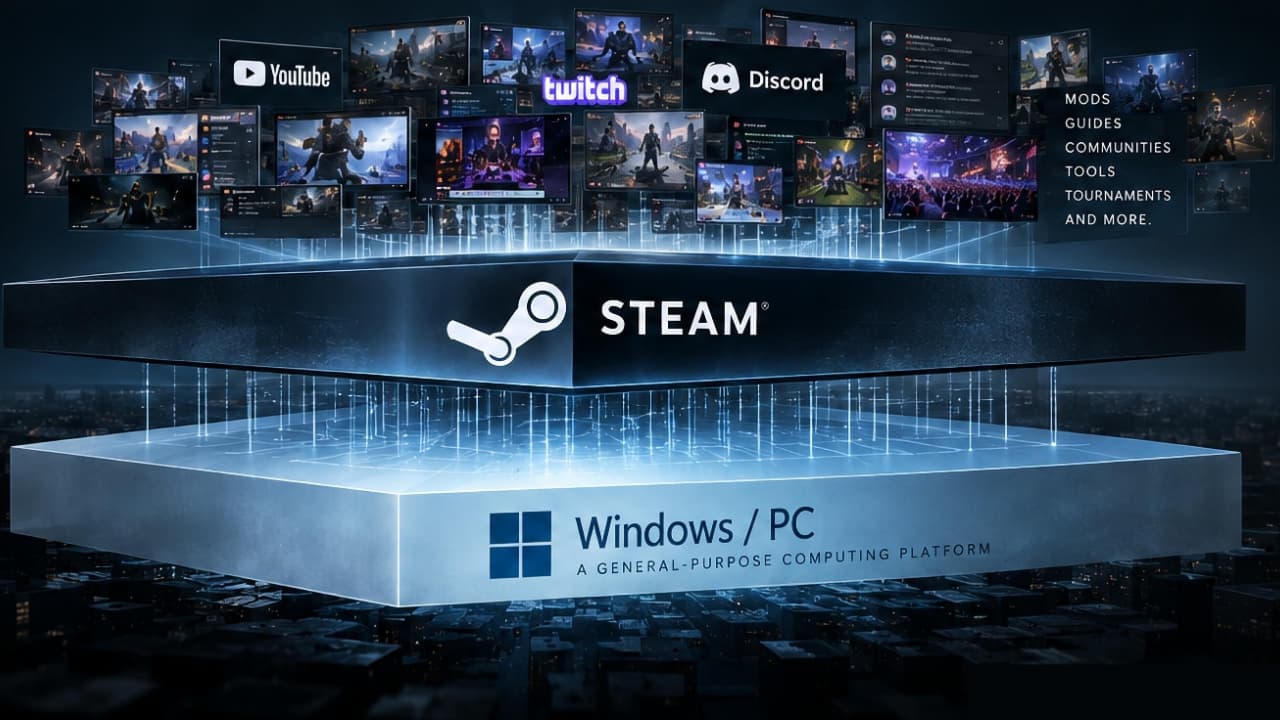
Steam is a platform built on another platform.
That fact is easy to overlook because Steam has become so culturally dominant that PC gaming and Steam are sometimes treated as nearly synonymous.
They are not.
Steam inherited an environment with a very different architecture from the traditional console.
Windows historically became powerful partly by functioning as a general-purpose software environment. Microsoft did not have to produce every important application that ran on Windows. Other companies could build browsers, media players, communication systems, creative tools, utilities, storefronts, games, and eventually entire platforms on top of it.
Steam itself is one of the greatest examples of what that architecture made possible.
Valve was able to build a gaming platform inside someone else’s operating system.
Then other systems grew around Valve’s platform.
The result is layered rather than vertically complete.
Windows provides the computational environment.
Steam provides a durable commercial and gaming layer.
Discord can provide a social layer.
Twitch can provide a broadcast layer.
YouTube can provide an archive, discovery system, and creator layer.
Independent communities can provide mods, documentation, tools, servers, competitions, and cultural memory.
No single company needs to coordinate the entire structure.
That produces inefficiency. Interfaces do not always match. Accounts fragment. Communities move. Services fail. Integrations break.
Openness is messy.
But the mess has an extraordinary property.
The ecosystem can discover capabilities that the platform owner never planned.
That is harder for a tightly closed system to reproduce.
VI.
The Game Can Escape Its Container
This matters because games increasingly live beyond the software executable.
A game can have a creator culture.
A competitive culture.
A modding culture.
A speedrunning culture.
A role-playing culture.
A meme culture.
A tutorial ecosystem.
A marketplace.
A Discord community.
A Twitch audience.
A YouTube archive.
A wiki.
A collection of tools built by people the original developer has never met.
Those things may become important to the identity of the game itself.
The game has escaped its container.
Steam Workshop is one example of Valve recognizing this directly. Valve describes Workshop as a place where fans and community members can participate in creating content for games. Steam can handle distribution and updating of that content, turning player creation into something structurally attached to the game.
But Workshop is only the portion Steam can see.
The larger phenomenon extends across the Internet.
A game’s cultural infrastructure can become vastly larger than the systems provided by its developer or distributor.
This changes what a platform should optimize for.
The question is no longer:
How do we provide every feature a game community needs?
That may be impossible.
The better question may be:
How easily can the things a community needs connect to the platform?
Those are very different architectural goals.
One attempts to predict culture.
The other prepares for culture to change.
VII.
The Value of What You Do Not Own
There is an instinct in platform strategy to treat anything outside the platform as leakage.
Time spent elsewhere is time lost.
Relationships formed elsewhere are relationships the platform does not own.
Content created elsewhere is content the platform cannot monetize.
But an ecosystem can produce another kind of value.
Thorhauge’s research on Steam describes economic activity that extends beyond Steam itself while remaining connected to markets created by the platform. The observation can be expanded culturally.
Activity outside a platform can increase the value of what exists inside it.
A Twitch creator has an incentive to find interesting games because interesting games produce interesting streams.
A YouTube creator has an incentive to explain complicated games because useful explanations produce audiences.
A Discord community has an incentive to organize players because active communities are enjoyable places to belong.
A modder may extend a game because they want something the developer never intended to build.
Each actor is pursuing a different objective.
Yet the resulting activity can increase discovery, understanding, participation, retention, or longevity for a game sold on Steam.
Valve receives benefits from systems it did not finance.
The developers receive benefits from communities they do not employ.
Players receive capabilities nobody centrally planned.
This is not merely network effect.
It is ecosystem effect.
The distinction matters.
A network becomes stronger as more participants join the same system.
An ecosystem becomes stronger as more complementary systems can participate without becoming the same system.
The participants do not necessarily have to join the same system either. In a cross-platform game, a player on a console can increase the value of the experience for a player on Steam while remaining entirely outside Steam.
Systems that compete at one layer can become complements at another.
Steam has both.
VIII.
The Wrong Way to Compete With Steam
This may explain why Steam can look deceptively reproducible.
A competitor can inspect Steam and make a checklist.
Storefront.
Library.
Friends.
Achievements.
Cloud saves.
Reviews.
Wishlists.
Forums.
Recommendations.
Mod support.
Build enough of the list and the competitor appears to be approaching feature parity.
But the checklist measures the visible platform.
It does not measure the environment around it.
A competitor is not only competing with Steam’s store.
It is competing with a player’s accumulated library.
Their friends.
Their history.
Their reviews.
Their Workshop subscriptions.
Their habits.
Their wishlists.
Their communities.
And then, outside Valve’s walls, it is competing with the fact that the player already knows how Discord, Twitch, YouTube, Reddit, browsers, mod managers, wikis, and the rest of the PC ecosystem fit into their gaming life.
Those systems do not appear on Steam’s feature list.
They still contribute to Steam’s position.
That makes the competitive object much larger than Valve.
Steam is the visible center of an ecosystem whose boundaries are difficult to draw.
Trying to defeat it by copying Steam features may therefore misunderstand what has to be reproduced.
IX.
The Durable Center
The lesson is not that every platform should become completely open.
Openness creates risks.
External services can disappear. Communities can fracture. Platform owners lose control over experience and moderation. Economic activity can migrate into spaces they cannot govern. Thorhauge’s work also makes clear that the relationship between platform participation and value creation is not neutral; interconnected systems create questions about labor, ownership, governance, and who ultimately captures the value communities produce.
Nor is Steam itself truly open in every meaningful sense.
Valve governs Steam.
It controls access to the marketplace, shapes discovery, sets platform rules, moderates participation, and determines how its own infrastructure evolves.
Steam is not the Internet.
The important characteristic is not absolute openness.
It is permeability.
Steam is permeable enough that cultural systems outside Valve can become meaningful parts of the experience of games inside it.
That makes the platform adaptable in a way a feature-complete system may not be.
Twitch does not have to exist forever.
Neither does Discord.
Neither does YouTube.
The specific services are less important than the architectural condition that allows successful external systems to attach themselves to gaming.
Twenty years from now, players may gather somewhere that does not exist today.
A durable platform cannot know what that place will be.
It can only decide whether there will be room for it when it arrives.
X.
Steam Is Not a Store
Steam succeeded at distribution.
Then it accumulated identity, libraries, relationships, reviews, markets, community spaces, creator infrastructure, and history.
But even that description stops too early.
Steam exists inside an ecosystem that continuously builds around it.
Creators generate attention.
Communities preserve interest.
Players create knowledge.
Modders create content.
External platforms create new forms of participation.
Windows gives much of this software somewhere to coexist.
Steam gives much of the resulting activity somewhere to land.
A stream becomes a wishlist.
A recommendation becomes a purchase.
A purchase becomes a library entry.
A session becomes history.
A player becomes part of a community.
A game becomes something larger than the software that shipped.
This helps explain why Steam is difficult to reproduce.
Its advantage is not one feature.
It is not one interface.
It is not even one platform.
It is the accumulated relationship between a durable center and an environment capable of continually changing around it.
The strongest platform may not be the one that owns every layer.
It may be the one that survives while the layers around it change.
Steam is not a store.
It is a place for an ecosystem to attach.
Sources
Huang, Yufeng, and Ilya Morozov. “The Promotional Effects of Live Streams by Twitch Influencers.” Marketing Science 44, no. 4 (2025): 916–932. DOI: 10.1287/mksc.2022.0400.
Thorhauge, Anne Mette. Games in the Platform Economy: Steam’s Tangled Markets. Policy Press, 2023.
Werning, Stefan. “Disrupting Video Game Distribution: A Diachronic Affordance Analysis of Steam’s Platformization Strategy.” Nordic Journal of Media Studies 1, no. 1 (2019): 103–124. DOI: 10.2478/njms-2019-0007.
Valve. “Steam Community.” Steamworks Documentation.
Valve. “User Reviews.” Steamworks Documentation.
Valve. “Wishlist Reporting.” Steamworks Documentation.
Valve. “Steam Workshop.” Steamworks Documentation.
Discord. “How Do I Create a Community For My Game?” Discord Developer Documentation, 2026.
Discord. “Discord for Game Developers.” Discord reports the usage figures cited in the essay from its own 2025 internal data.