Webb Systems Essay
Physical Gaming Beyond the Disc
How Xbox could reinvent physical ownership, retail, and the economics of game distribution.
What We Took Home
I spent part of my early adulthood working in three different entertainment businesses located in the same mall. One was MusicLand, which became Sam Goody. Another was Software Etc., which became GameStop. The third was a movie theater where I operated the projectors.
At the time, music, movies, and video games were distinct businesses, but they shared something fundamental. Entertainment was something people could physically take home.
A new album wasn't simply music. It was an object with cover art, liner notes, and a place in someone's collection. A movie came in a case that could sit on a shelf beside dozens of others. Video games arrived in boxes containing cartridges or discs, manuals, artwork, and sometimes additional materials that made the purchase feel special.
People didn't always know what they were going to buy when they entered those stores. Sometimes they came looking for a specific release. Other times they discovered something while browsing, talking with employees, or seeing what other customers were buying.
I've written before about the cultural importance of these stores. They were gathering places, places of discovery, and part of the social infrastructure surrounding entertainment.
But there's another aspect of physical retail worth examining.
The products themselves had value beyond the entertainment they delivered.
You could lend a game to a friend, trade it toward another purchase, sell it, or give it away. You could display your collection, compare editions, and keep something associated with an experience long after you finished it.
Physical ownership created activities around entertainment that were separate from consuming the entertainment itself.
Digital distribution has made purchasing and accessing games considerably more convenient. I wouldn't argue otherwise. I've purchased almost exclusively digital games for nearly a decade. I appreciate being able to purchase a game without leaving home, maintain a library without shelves full of cases, and move between installed games without changing discs.
But the convenience of digital distribution doesn't automatically eliminate the value of everything physical distribution provided.
The industry increasingly treats physical media as a legacy problem, something to maintain until the market becomes small enough to abandon.
I think that's worth reconsidering.
Not because I believe we should return to an earlier era of gaming, but because the technology responsible for delivering physical games may no longer be the best technology for preserving their value.
And my interest in that question comes from another part of my background.
Learning to See the Supply Chain
I studied Supply Chain Management at Iowa State University.
That education gave me a different perspective on the products sitting on retail shelves. A product isn't simply manufactured and sold. It moves through a network of decisions involving materials, suppliers, production schedules, transportation, warehousing, inventory management, and demand forecasting.
Every decision carries costs. Every forecast introduces uncertainty.
Retailers need products available when customers want them. Manufacturers need sufficient production capacity to meet demand. Distributors have to move those products to the right places at the right times.
Too little inventory means lost sales. Too much inventory ties up capital and creates pressure to discount merchandise that doesn't sell.
Later, while living in China and operating a small technology business, I gained another perspective on how production and business operations depend on the coordination of people, resources, and suppliers.
My subsequent experience with e-commerce and dropshipping brought those considerations into a different kind of retail environment.
Traditional retail frequently requires inventory to be manufactured and positioned before customers purchase it. Dropshipping separates parts of that process, allowing the retailer to arrange fulfillment through suppliers after an order is placed.
That doesn't eliminate costs or operational problems. It changes where inventory is held, who manages fulfillment, and how businesses respond to demand.
I came to appreciate that two businesses selling the same product could operate with very different cost structures simply because of how their supply chains were organized.
And that distinction matters when examining physical video games.
For decades, the industry built an enormous infrastructure around manufacturing, packaging, shipping, and selling games stored on physical media.
That infrastructure made sense when the physical medium was essential to delivering the game.
But what happens when it no longer is?
The Disc and the Game Have Already Separated
Consider how many modern console games are purchased and played.
A customer visits a retailer, purchases a boxed game, brings it home, inserts the disc into the console, and installs the game.
Depending on the title, substantial additional data may need to be downloaded. Updates, patches, expansions, and online features may require further downloads throughout the game's life.
Some discs still contain complete, playable versions of their games. Others contain only part of the installation or depend on additional online delivery.
In 2026, research by the game-preservation group DoesItPlay found that approximately 66% of its tested PlayStation 5 releases and 50% of its tested Xbox Series X releases were complete and playable as intended without a download. The Xbox sample was substantially smaller, so the percentages shouldn't be treated as representative of every release. But the results illustrate how uneven the relationship between physical media and game data has become.
The disc remains essential for certain games and for preservation, particularly when it contains a complete playable installation. Yet for other releases, it increasingly serves two functions: delivering some game data and providing physical proof that the customer is entitled to play.
That second function has become particularly interesting.
In August 2026, Microsoft announced Disc-to-Digital, allowing supported Xbox game discs to establish digital entitlements that can be used across eligible Xbox devices and services.
The entitlement remains conditioned on continued possession of the physical disc. It can also pass to another player who claims the entitlement using that disc, removing the previous player's digital access.
This matters because Microsoft has already established much of the relationship between physical possession and digital access that a new physical format would need.
Meanwhile, the wider industry is moving further toward digital distribution.
On July 1, 2026, Sony announced that it would discontinue physical-disc production for new PlayStation releases beginning in January 2028. The decision does not eliminate previously released physical games, but it marks a significant change in the industry's largest console ecosystem.
From a supply-chain perspective, I understand the motivation.
Optical drives add hardware complexity and manufacturing expense. Disc replication requires specialized production capacity. Physical game releases introduce inventory forecasting, manufacturing commitments, distribution costs, and unsold stock.
Eliminating those systems can simplify operations.
But I think there's another possibility.
What if the solution isn't to eliminate physical ownership?
What if it's to replace the physical medium?
Project Onyx
Project Onyx is a proposed physical game format built around a secure, collectible metal card rather than an optical disc.
The idea is straightforward.
A customer purchases a physical Xbox game in a compact retail case. Inside is a metal card featuring the game's artwork, a distinctive metallic finish, and an embedded security chip.
The card doesn't need to contain the game's installation files.
Instead, it acts as a secure, transferable physical license.
On a compatible Xbox console, the customer inserts the card into a reader. The console authenticates it, recognizes the game, and makes the appropriate installation available.
The game can then be downloaded and played using the Xbox ecosystem's existing digital infrastructure.
Unlike a conventional physical disc, the card wouldn't need to remain inserted while the customer plays. Once authenticated, the game would appear in the owner's digital library and remain playable until the card was used to transfer the entitlement elsewhere.
The customer could switch between installed games without changing physical media. The cards could remain safely stored or displayed in a collection.
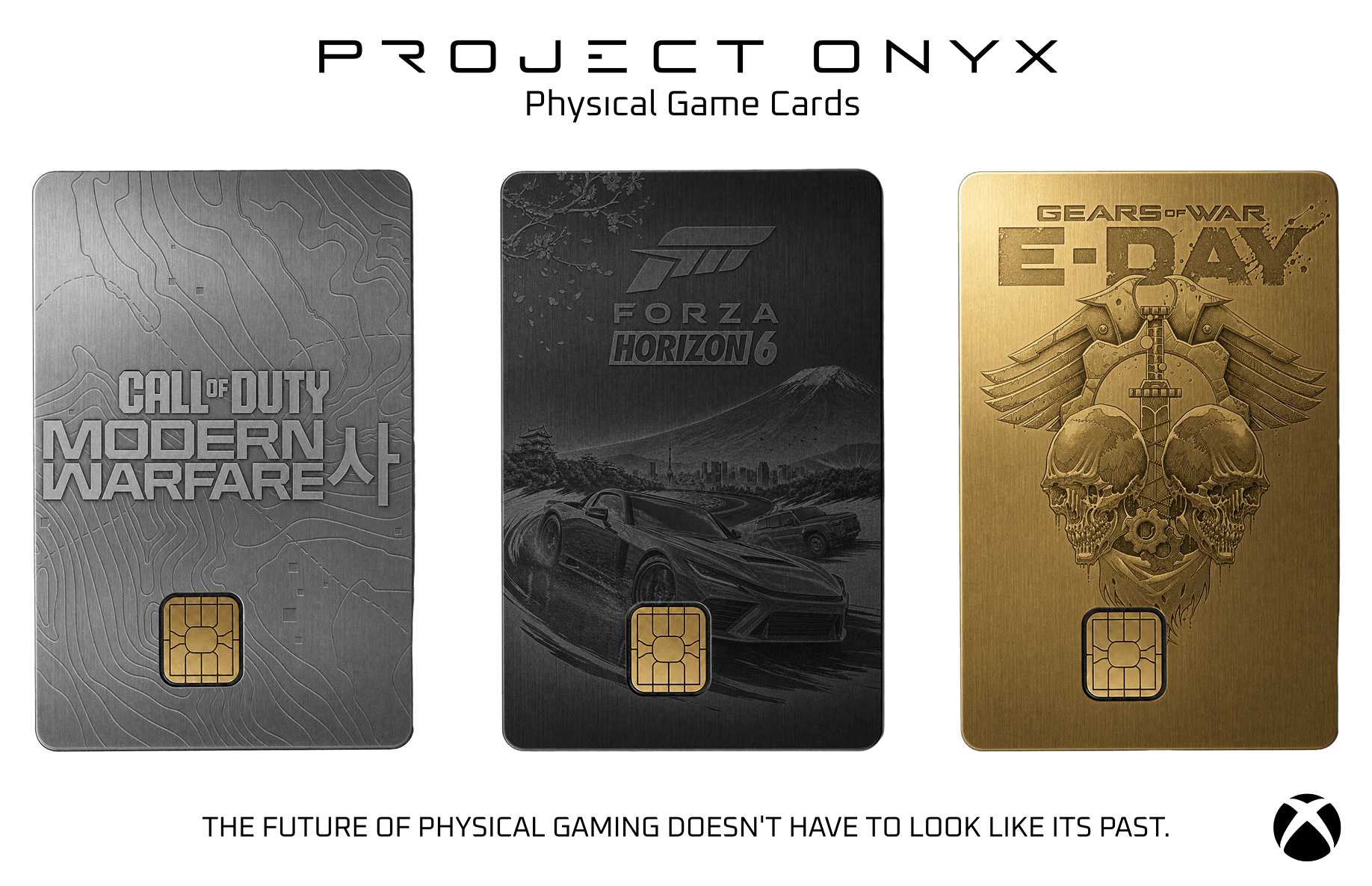
And unlike a single-use digital activation code, the card would continue to represent the playable license throughout its useful life.
I would retain the physical insertion slot deliberately.
There's something deeply familiar about inserting a game into a machine. From dropping quarters into arcade cabinets to loading cartridges and discs into consoles, that interaction has been part of gaming culture for decades.
It signals the beginning of an experience.
A contactless reader might be convenient, but I wouldn't want to remove the insertion ritual simply because the technology no longer requires it.
At the same time, there's an opportunity to support contactless authentication for devices without a dedicated reader.
A dual-interface smart card could potentially allow a customer to open the Xbox app on an NFC-capable smartphone or handheld, tap the card, and authenticate the game for installation on a supported Windows PC.
That would allow Onyx to serve both console and PC players without requiring every computer to contain a specialized reader.
The metal construction would also create a distinctive physical object: durable, engravable, and suitable for collectible designs. The card would still require careful engineering to protect its chip, contacts, and contactless antenna, but it wouldn't have the exposed optical surface of a conventional disc.

Legacy discs would require a separate solution. I would explore supporting certified, off-the-shelf external Blu-ray drives for compatible older Xbox titles rather than building an optical drive into every new console.
That would require real engineering and licensing work, particularly for encrypted legacy discs. It isn't a capability Microsoft has announced for Helix.
But the objective would be clear: preserve existing physical libraries while modernizing the format used for future releases.
The result could be a physical product that preserves familiar gaming behavior while using a considerably different manufacturing and distribution system.
And that brings us to the economics.
The Economics of a Physical Game
One of the first things I wanted to examine was the bill of materials.
If we're proposing to replace Blu-ray discs with metal cards, we need to understand what each system actually costs.
The comparison begins inside the console.
In 2013, IHS estimated that the original Xbox One's optical drive contributed approximately $32 to the console's bill of materials. A later analysis estimated the Xbox One S UHD Blu-ray drive at approximately $33.50.
Those are historical estimates, not current Xbox or Project Helix manufacturing costs. But they demonstrate that optical drives have represented a meaningful hardware expense.
A contact-based smart-card reader is a fundamentally simpler mechanism.
Published electronics-distributor listings include smart-card connectors costing less than a dollar. A complete console reader would require additional circuitry, physical mounting, security integration, and testing, but it would not need a spinning disc assembly, optical pickup, or disc-loading motor.
That creates a plausible opportunity to reduce hardware manufacturing costs and mechanical complexity.
It could also reduce some sources of hardware failure, although actual reliability savings would require testing rather than assumptions.
The interesting part is that these potential savings apply across every console manufactured with the new reader, regardless of how many physical games its owner eventually purchases.
The physical game itself introduces a different calculation.
Blu-ray discs are inexpensive to manufacture in quantity. Published commercial replication prices place a 50GB Blu-ray disc at approximately $1.40 per unit in a 5,000-unit production run.
Meanwhile, manufacturers already produce metal NFC and smart cards for identification, banking, access control, and promotional applications.
A preliminary target of approximately $1.50–$2.50 per Onyx Card is worth investigating, but that figure isn't yet a verified quotation for a game-grade, dual-interface cryptographic card. Secure provisioning, customization, contactless antenna engineering, and authentication requirements could increase the cost.
Packaging presents another opportunity.
Traditional optical games use relatively large plastic cases. Onyx could use the more compact dimensions associated with CD packaging, replacing the brittle conventional jewel case with a flexible polypropylene case and a custom insert designed to hold the metal card securely.
One published supplier offers a polypropylene CD case with a full artwork sleeve for approximately $0.41 per unit at quantities of 5,000 or more, before any modifications required for Onyx.
A compact case could preserve familiar retail presentation while potentially improving resistance to breakage.
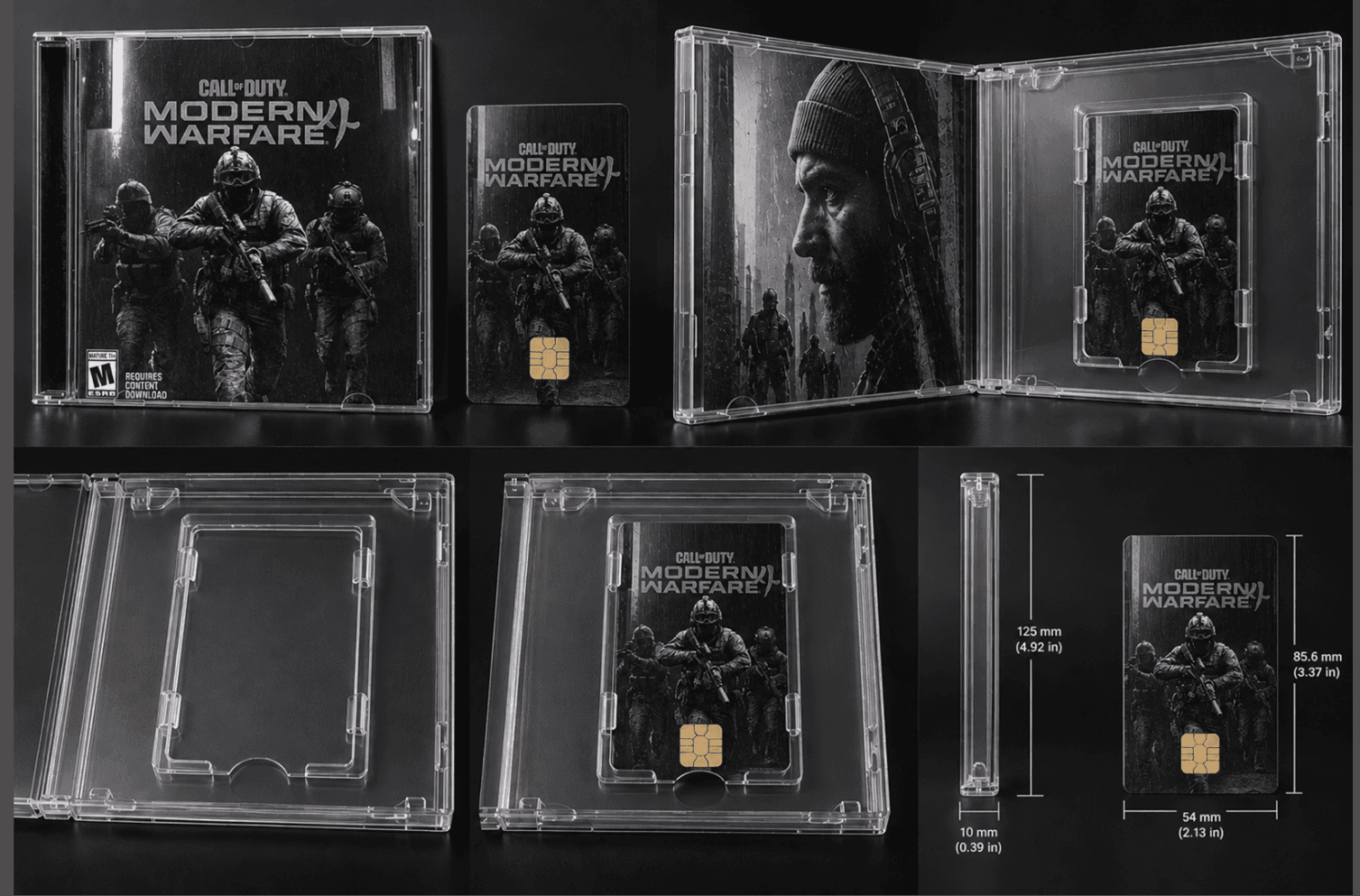
The preliminary economics look like this:
| Component | Existing optical model | Proposed Onyx model |
|---|---|---|
| Console reader | Historical optical-drive BOM: $32–$33.50 | Inexpensive smart-card connector plus reader electronics |
| Physical game medium | 50GB Blu-ray: ~$1.40 at 5,000 units | Metal smart card: $1.50–$2.50 preliminary target |
| Retail packaging | Larger Blu-ray/DVD-style case | Compact polypropylene CD-style case: ~$0.41 before custom insert |
| Game installation | Disc data and/or digital downloads | Digital download |
| Mechanical design | Optical pickup, motors, loading mechanism | Solid-state electronics and card-contact mechanism |
These figures come from different years, suppliers, and order quantities. They are useful reference points, not a verified apples-to-apples Xbox manufacturing quotation.
And the full commercial calculation needs to go well beyond the component prices.
An Onyx Card might cost somewhat more than a replicated disc. But that additional expense could be supported by higher retail pricing, while the console itself potentially benefits from a less expensive reading mechanism.
The smaller package might also improve warehouse utilization, carton density, shipping efficiency, and the number of products that can be stocked in a given retail area.
Durability becomes part of the calculation, too. A less brittle case and a metal card could potentially reduce some forms of damage during manufacturing, transportation, and retail handling.
Those savings must be measured. A compact case still needs sufficient shelf visibility, protective construction, and a reliable way to hold the metal card without damaging its contacts or finish.
The more important point is that we're examining two different economic opportunities.
One is reducing the cost of manufacturing the hardware.
The other is increasing the commercial value of the physical game.
And the second may prove just as important as the first.
Making the Physical Game Valuable Again
Traditional physical and digital editions of the same game are often priced similarly.
But they don't necessarily offer customers the same value.
A digital purchase provides convenience. A transferable physical copy can also be collected, displayed, lent, traded, or resold.
What interests me about Onyx is that it wouldn't require customers to sacrifice the conveniences that persuaded many of us to purchase digitally in the first place.
I've been buying digital games for almost a decade. I have little interest in returning to the routine of changing discs every time I want to play something different.
Yet if Onyx existed, I could imagine my library looking considerably different.
For the games I'm most excited about, I'd probably purchase Gold Editions. Other anticipated releases might earn a place in my collection as Black First Editions. And for games I wasn't certain about at launch, I'd be happy purchasing a Silver Edition later, particularly during a sale.
I'd still be playing those games digitally.
The cards would remain in my collection, ready whenever I wanted to lend, trade, or resell one.
That's a distinction worth exploring commercially.
Onyx wouldn't necessarily be asking an existing physical-game customer to pay more for a replacement disc. It could persuade customers who had already moved entirely to digital purchasing to spend more on a physical edition.
If the additional value is meaningful, a higher price becomes a choice rather than an obligation.
Consider a proposed $69.99 digital release alongside a $74.99 Silver Onyx Edition.
The extra five dollars purchases a tangible product with a distinctive design and transferable ownership.
From there, Xbox could establish a universal edition system built around three metallic finishes.
Silver would represent the Standard Edition, manufactured and replenished according to demand.
Black would represent a numbered First Edition, produced in a limited quantity determined by the game's expected physical sales.
Gold would represent a more exclusive Premium Edition, offered either as a standalone card or inside an elaborate Collector's Edition containing merchandise such as art books, statues, soundtracks, or clothing.
An illustrative pricing structure might place Silver at $74.99, Black at $79.99, and Gold at $94.99 against a $69.99 digital release.
All editions would deliver the same game and the same ownership rights. The differences would be physical craftsmanship, artwork, scarcity, and collectible presentation.
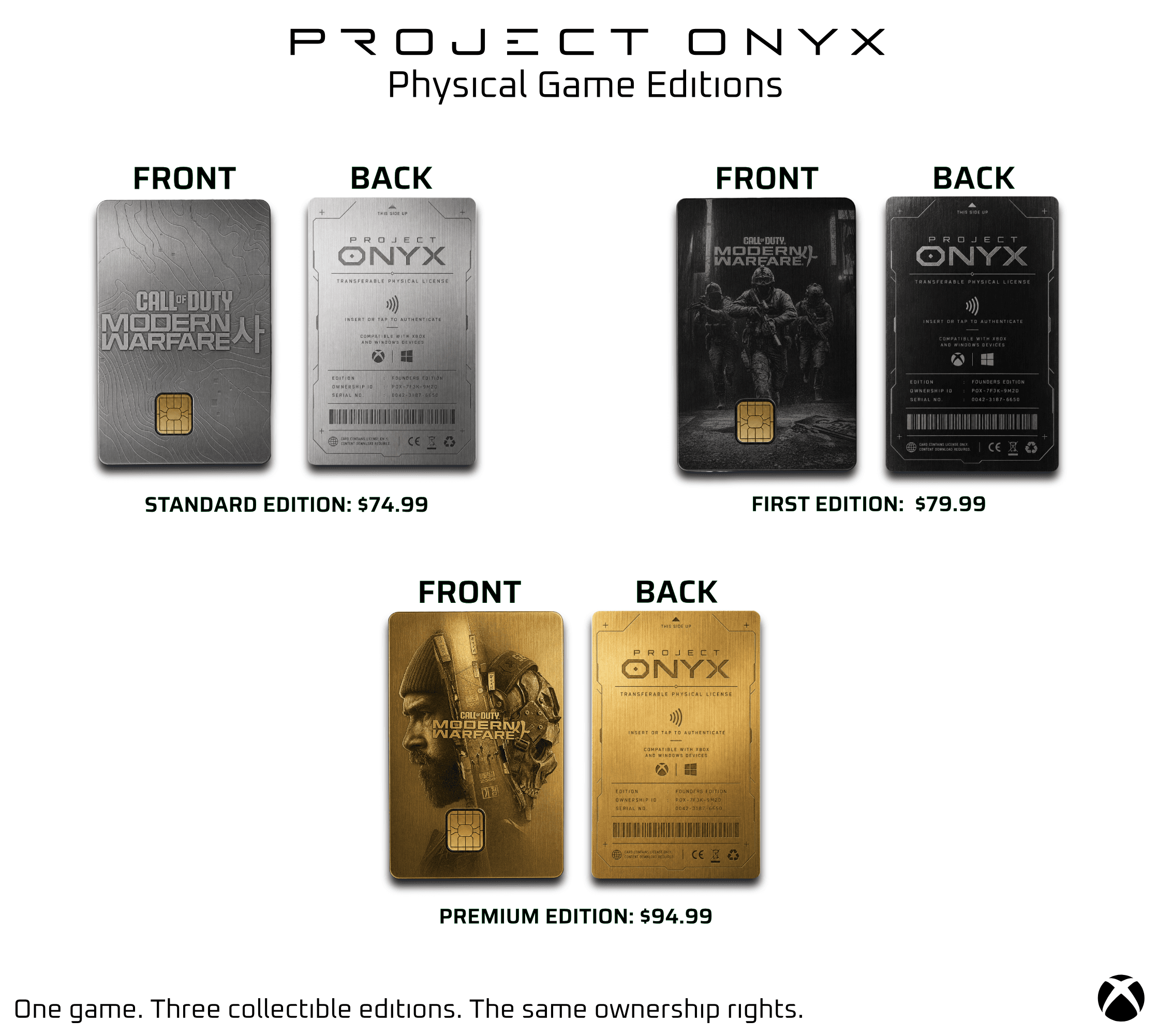
The system would be standardized across Xbox, but the production quantities would scale with each game's commercial expectations.
A major release might justify 100,000 Black First Editions. A smaller game might justify only a few thousand.
The important principle is that limited editions remain limited.
Once an announced numbered edition sells out, it isn't reproduced.
That doesn't prevent a successful game from receiving future commemorative releases. If it achieves a predefined sales milestone, Xbox could authorize a new limited Gold Edition featuring different artwork, branding, and numbering.
The original remains distinct. The new edition celebrates the game's success.
The merchandise around a sold-out Collector's Edition could continue to be sold separately without reproducing the limited game card or original bundle.
That lets publishers monetize continuing interest in the game's merchandise without compromising the scarcity promised to early collectors.
There is also an opportunity to make initial Gold purchases more resistant to scalping.
Instead of releasing every card into an unrestricted online checkout, Xbox could offer initial Gold access to established players with verified account histories and meaningful gaming activity.
Multiple legitimate gamers in the same household should be eligible independently. Buying additional consoles or creating inactive accounts should not automatically create additional purchase opportunities.
When demand exceeds supply, a randomized allocation process could give eligible players a fairer opportunity than a race against automated purchasing software.
After purchase, the card would retain normal lending and resale rights.
The goal isn't to control the collector market. It's to give actual players a reasonable opportunity to participate in it.
I suspect these products could generate something physical games have lost much of in the transition to digital distribution: excitement around the product itself.
People could share their numbered cards, compare artwork, photograph their collections, trade editions, and celebrate new releases.
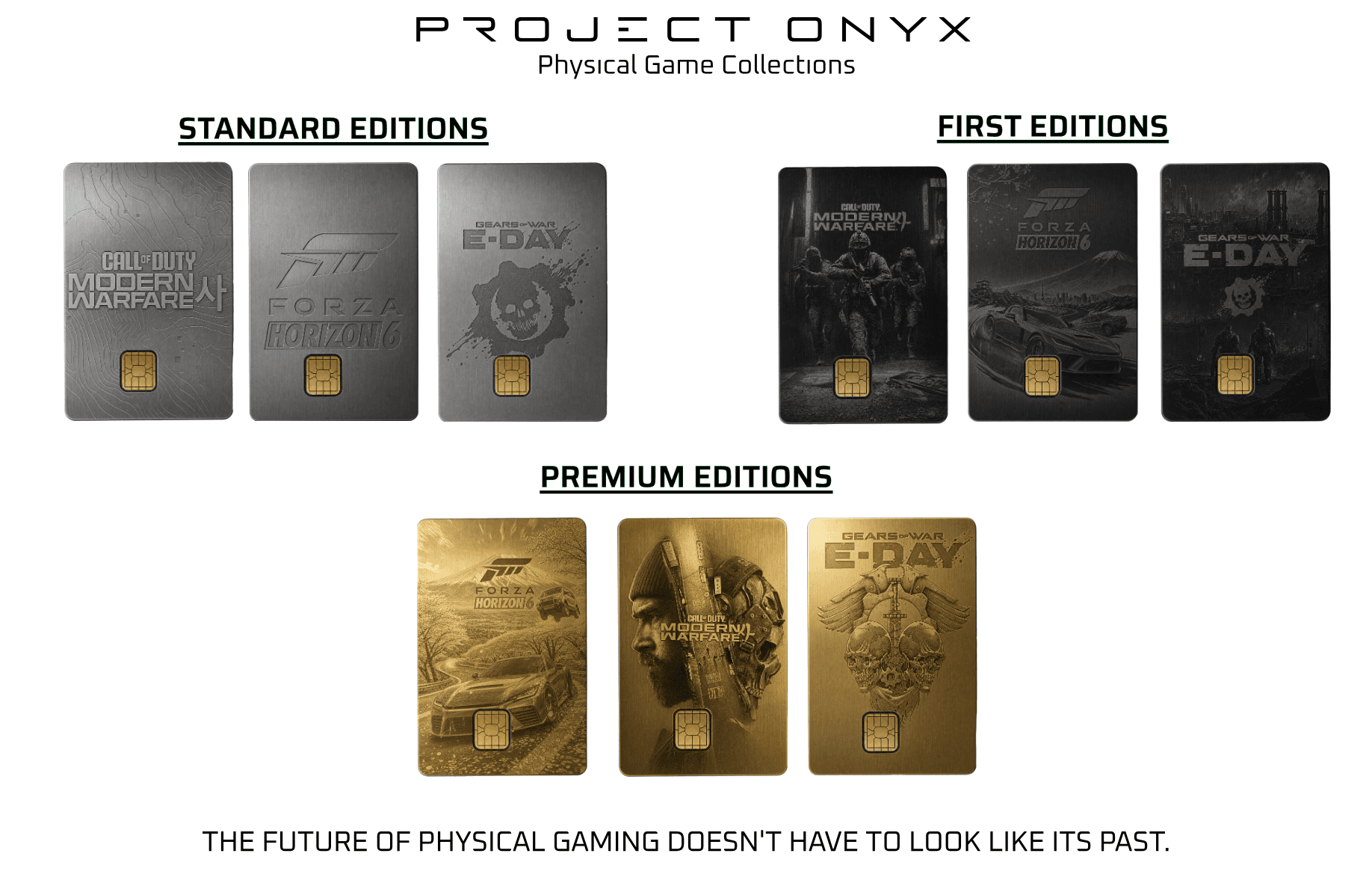
The opportunity becomes even more interesting across different genres. A racing-game card could resemble luxury automotive memorabilia. A fantasy RPG might feature an engraved character or artifact. A sports title could incorporate the visual language of collectible player cards, potentially appealing to fans who don't even own a console.
The card wouldn't simply be a package surrounding a game. It would be a separate physical artifact with its own design, manufacturing history, scarcity, and association with a particular release.
That matters even after the software itself becomes obsolete.
An old arcade cabinet may no longer operate, but that doesn't automatically make it worthless. A cartridge can become a collector's item even when the console it was designed for is difficult to maintain.
A metal Onyx Card could carry a similar kind of historical and cultural significance.
Collectibility doesn't guarantee a financial return, of course. Scarcity only matters when people care about what is scarce.
But it means the customer's purchase has a potential source of value that exists independently of the game servers, storefront, or console.
And while that collectible value is important, the card's functional value matters just as much.
Because unlike a conventional collector's item bundled with a digital activation code, the Onyx Card itself remains essential to the game license.
The collectible is the license.
A New Reason to Choose Xbox
One of the most interesting possibilities for Onyx comes from combining physical ownership with digital access.
Microsoft's Disc-to-Digital program has already established the basic principle: a physical game can authorize a digital entitlement that remains active without requiring the disc to stay inserted.
The entitlement can be reassigned when another player authenticates using the physical medium.
Onyx would replace that medium with a secure card.
Imagine visiting a friend's house with an Onyx Card in your pocket.
You insert the card into their Xbox, or potentially tap it against an NFC-capable phone while they're signed into their Xbox account.
The playable entitlement transfers to your friend. They can download and play the game using their own account, preserving their own achievements and saved progress.
When you return home, you insert the card into your Xbox. The entitlement returns to you, and your friend's access ends.
No separate lending application. No loan-return process. No exchange of account credentials.
The physical card determines who currently has access to the transferable license.
And there's an interesting consequence.
Your friend already has the game installed. Their progress is saved. If they want to continue playing after you reclaim the license, they can purchase their own copy.
The lending experience can become a form of discovery that leads naturally to another sale.
It also creates a more appealing alternative to piracy.
Piracy won't disappear simply because legitimate games become more desirable. But some people who might otherwise obtain unauthorized copies could find genuine value in a product they can lend, trade, resell, and collect.
Instead of relying entirely on additional restrictions, Xbox would be increasing the benefits of purchasing legitimately.
And critically, none of that would require the owner to give up the everyday conveniences of digital gaming.
A collection of 50 Onyx Cards wouldn't require someone to change cards every time they switched games. The games would already be installed and playable through their digital library, provided the entitlements remained with their account.
The cards would become necessary when transferring access, not whenever the owner wanted to play.
This is where I think the relationship between physical and digital gaming becomes particularly productive.
The physical object establishes and transfers ownership.
The digital infrastructure delivers the experience.
Each does what it does best.
The commercial opportunity extends beyond consoles, too.
At the Game Developers Conference in March 2026, Jason Ronald described Microsoft's effort to bring Xbox console and Windows PC gaming closer together.
Project Helix is designed to play Xbox console and PC games. Microsoft's broader strategy includes a more consistent experience across devices, shared development infrastructure, and an expanding Xbox Play Anywhere catalog.
Most modern gaming PCs don't include optical drives. And physical PC releases frequently use account-bound activation codes rather than transferable licenses.
An Onyx Card authenticated through a smartphone could provide a different purchasing experience.
Imagine a Windows gamer deciding where to buy the next major role-playing game.
Steam offers its familiar storefront, community features, and digital library. Xbox already offers many of the same basic advantages of PC ownership, including the ability to access eligible purchases across different Windows computers.
But Xbox could introduce something Steam generally doesn't provide for activated purchases: a physical edition with a transferable entitlement.
The customer could purchase a numbered metal card at a local game store, through an online retailer, or directly from Xbox.
The game itself would download through the Xbox ecosystem, just as a conventional digital purchase would.
For participating Play Anywhere titles, that purchase could also provide access on compatible Xbox devices.
The customer doesn't have to abandon Steam.
They simply have a new reason to purchase that particular game through Xbox.
After several purchases, they have the beginnings of a physical Xbox PC collection alongside their existing Steam library.
Competing for future purchases doesn't require convincing customers to abandon everything they already own.
And it doesn't require removing the retailer from the equation.
Steam and Xbox already support the sale of digital activation codes through third-party retailers. But those codes generally become permanently associated with a customer's account after redemption.
An Onyx Card would be different.
It could remain a transferable physical product throughout its useful life, even though the software itself is delivered digitally.
That gives independent retailers something more durable to sell than a single-use activation code.
They could carry new releases, limited editions, pre-owned cards, and collectible merchandise. Physical games could remain part of the retail economy without relying on optical discs to deliver their data.
The opportunity on consoles is different.
Sony's announced transition away from physical discs for new releases could leave some longtime PlayStation collectors looking for an alternative.
Imagine someone who has spent decades collecting PlayStation games suddenly seeing limited Gold Editions of major fantasy RPGs, action games, and other participating third-party titles available through Xbox.
Those games would remain playable digitally elsewhere, but Xbox would offer a distinct physical product.
That could give some collectors a reason to purchase Helix alongside the hardware they already own.
Not every collector would make that decision, and the size of the market would need to be measured.
But it would give Xbox a point of differentiation that doesn't depend entirely on graphical performance, subscription pricing, or exclusive game content.
Helix could become a complementary living-room device for existing PC gamers, while Onyx gives collectors another reason to participate in Xbox.
The same card format could potentially serve consoles, compatible handhelds, and Windows PCs, with the entitlement following the customer across participating devices.
That's a significantly larger commercial opportunity than merely replacing an optical drive.
It also suggests a different approach to the future of digital commerce.
Consumers and regulators are becoming more interested in what it means to purchase digital content, what rights remain when services change, and what happens when a provider stops supporting a product.
In June 2026, the European Commission responded to the Stop Destroying Videogames citizens' initiative, which had gathered more than 1.29 million verified signatures. The Commission did not propose a legal requirement to keep every game playable indefinitely, but it announced plans to work with industry and consumer representatives on better practices for managing games at the end of their commercial lives.
Onyx wouldn't automatically satisfy future consumer-protection requirements. A transferable license doesn't solve every issue surrounding server-dependent games.
But it could position Xbox to respond to changing expectations with a product that restores lending, gifting, resale, and independent retail participation.
Microsoft could retain the efficiencies of digital software delivery while giving consumers meaningful benefits traditionally associated with physical ownership.
That strikes me as a potentially valuable direction for both the business and the customer.
Building on What Xbox Has Already Done
Any new physical format would need to demonstrate that it works technically, commercially, and operationally.
But I don't think Project Onyx would require Microsoft to discover an entirely new philosophy of game ownership.
Xbox has already invested considerably in carrying customers' purchases forward.
When Microsoft closed the Xbox 360 Marketplace in July 2024, it preserved access to previously purchased games and downloadable content. Supported titles remained playable on newer Xbox consoles through backward compatibility, and customers could continue redownloading their purchases.
In July 2025, Microsoft stopped selling new movies and television programs through its Movies & TV storefront. But customers retained access to their existing purchases through supported Xbox and Windows devices, including downloaded playback on Windows.
These weren't perfect solutions to every possible question about permanent digital ownership. They were, however, examples of Microsoft maintaining access to purchased entertainment after a storefront changed or closed.
The introduction of Disc-to-Digital in 2026 extends that pattern.
Instead of leaving physical customers behind as Xbox moves toward a more unified console-and-PC ecosystem, Microsoft is attempting to connect supported disc ownership to digital access.
And Project Helix's stated commitment to games from four generations of Xbox demonstrates that backward compatibility remains part of the company's forward strategy.
Onyx would build on those investments.
The new format wouldn't require every game publisher to abandon its existing distribution infrastructure or Xbox to create a completely separate storefront.
Its purpose would be to connect transferable physical ownership to the digital systems Xbox is already developing.
The entitlement model is particularly important. Microsoft has already demonstrated the relationship between a physical game and a revocable digital license that can follow the medium to another player.
Onyx would need a new authentication mechanism, reader hardware, NFC integration, and appropriate licensing support. But it wouldn't be inventing that ownership behavior from scratch.
There is still an important preservation distinction.
An Onyx Card containing no game data cannot independently install a complete game if every source of downloadable software disappears. A disc containing a fully playable game retains an advantage in that circumstance.
No current mainstream digital distribution model guarantees perpetual access to every game under every possible future condition.
Onyx wouldn't change that fact.
But it could represent a step toward a different balance between digital convenience and physical ownership, building on Xbox's record of maintaining access to past purchases.
The outstanding questions are practical ones.
Can a secure smart-card format reliably authenticate ownership across devices? Can the entitlement transfer between customers without fraud, duplication, or accidental loss of access? Can publishers support the model without introducing licensing conflicts? Can the necessary hardware and packaging be manufactured at the expected costs?
The ability to maintain appropriate entitlement behavior during network outages would also need careful engineering, particularly when a card has been authenticated on multiple devices at different times.
And most importantly, will customers find the result valuable enough to support the additional expense?
The higher proposed retail prices don't automatically translate into higher profits. Manufacturing, retailer margins, publisher agreements, logistics, and unsold inventory all affect the result.
A transferable resale market also introduces tradeoffs. Some used-card purchases might replace new-game sales, while lending and collecting could generate additional demand.
The appropriate question isn't whether every Onyx transaction would produce more revenue than a digital sale.
It's whether the entire model creates more value for Xbox, its publishing partners, retailers, and customers than the alternatives.
I would begin with a limited group of games, a small physical production program, and a clear set of performance measurements.
The pilot should evaluate reader reliability, card durability, authentication, transfers, production yields, retail sell-through, returns, customer demand, and the extent to which physical editions generate purchases that might otherwise have gone to competing storefronts.
Only after answering those questions would I consider a broader transition.
One lesson my Supply Chain Management education reinforced is that a promising idea still has to survive contact with the actual operation.
A product can look profitable in a spreadsheet and fail because of poor forecasting, supplier constraints, quality problems, or customer behavior.
The purpose of a pilot isn't simply to demonstrate that the technology works.
It's to determine whether the entire business model works.
The Physical World Is Still Part of Gaming
When I think back to those years working in entertainment retail, I don't remember the technical specifications of the discs sitting in the cases.
I remember the products, the stores, the excitement around new releases, and the relationships people developed with the entertainment they purchased.
Those experiences weren't created by optical storage technology.
The technology made them possible, but it wasn't what gave them meaning.
Somewhere along the transition to digital distribution, the industry began treating the physical product and the physical delivery mechanism as though they were inseparable.
They aren't.
A game can be downloaded digitally while its ownership remains represented by something tangible.
A customer can participate in a digital ecosystem while still collecting physical products associated with the experiences they love.
And an entertainment company can modernize its supply chain without abandoning every source of value that its older distribution system created.
Project Onyx is one proposed way to explore that possibility.
It may ultimately prove that some physical formats are worth preserving while others are not. It may reveal that the strongest opportunity is in collectors' editions rather than standard releases. Or it may demonstrate that a modern physical format can operate profitably alongside digital distribution.
Those answers require testing.
But there's a larger question worth considering.
Imagine a future in which the console that originally played a game has long since disappeared. The storefront that sold it no longer operates. Perhaps the software itself can no longer be played.
A numbered Onyx Card could still exist on someone's shelf.
Its artwork, craftsmanship, scarcity, and association with a particular period in gaming history would remain.
It might have collectible value. It might have sentimental value. It might simply remind someone of a game they loved, a friend they played with, or an experience they shared.
That doesn't replace the importance of preserving playable games. It preserves something different.
Physical ownership has always been about more than the utility of the object. The things we keep become part of the history of what we experienced.
And during the useful life of the game, the card would remain more than a keepsake.
It would still be the thing that allowed its owner to lend, gift, trade, or resell the right to play.
That's the distinction I find most interesting.
The Onyx Card wouldn't merely commemorate a digital purchase.
The collectible would be the license.
I don't believe technology should have to move backward to preserve those connections.
Nor do I believe progress requires abandoning them.
The gaming industry has spent years asking how quickly it can move away from physical media.
Perhaps it should also be asking what physical media could become.
The future of physical gaming doesn't have to look like its past.
But that doesn't mean it has to leave the physical world behind.
Source and Project Context
This essay presents Project Onyx as an independent conceptual proposal, not an announced Microsoft or Xbox product. Hardware, entitlement, manufacturing, security, and commercial assumptions require validation.
Key public references:
- Xbox — From GDC: Building the Next Generation of Xbox, March 11, 2026.
- Xbox — Your Discs. Now Also Digital., August 26, 2026.
- Microsoft — Usage Rules for Digital Goods, for current Disc-to-Digital entitlement conditions.
- Xbox — The Xbox 360 Store Will Close July 2024, August 17, 2023.
- Microsoft Support — Movies & TV purchases and playback.
- PlayStation — Physical Disc Production Ending in January 2028, July 1, 2026.
- DoesItPlay — Physical-game testing and preservation research, with 2026 findings reported by Ars Technica and TechSpot.
- European Commission — Response to Stop Destroying Videogames, June 16, 2026.
- Historical IHS optical-drive BOM estimates reported by Electronics360 and EE Times.
- Published component and packaging reference prices from DigiKey, Central Media, and CCI Solutions. These are indicative benchmarks, not verified Xbox production costs.